MITOCHONDRIA & ENERGY METABOLISM
What Elevated Succinic Acid Is Really Telling You
Why Succinic Acid Matters
Most markers on an Organic Acids Test tell you about one step in a pathway. Succinic acid tells you about a handoff.
It sits at the exact point where fuel processing in the Krebs cycle passes its electrons into the electron transport chain — the machinery that actually builds ATP. That's not a small detail. It's what makes succinate worth understanding well, even though it rarely gets the attention that flashier markers do.
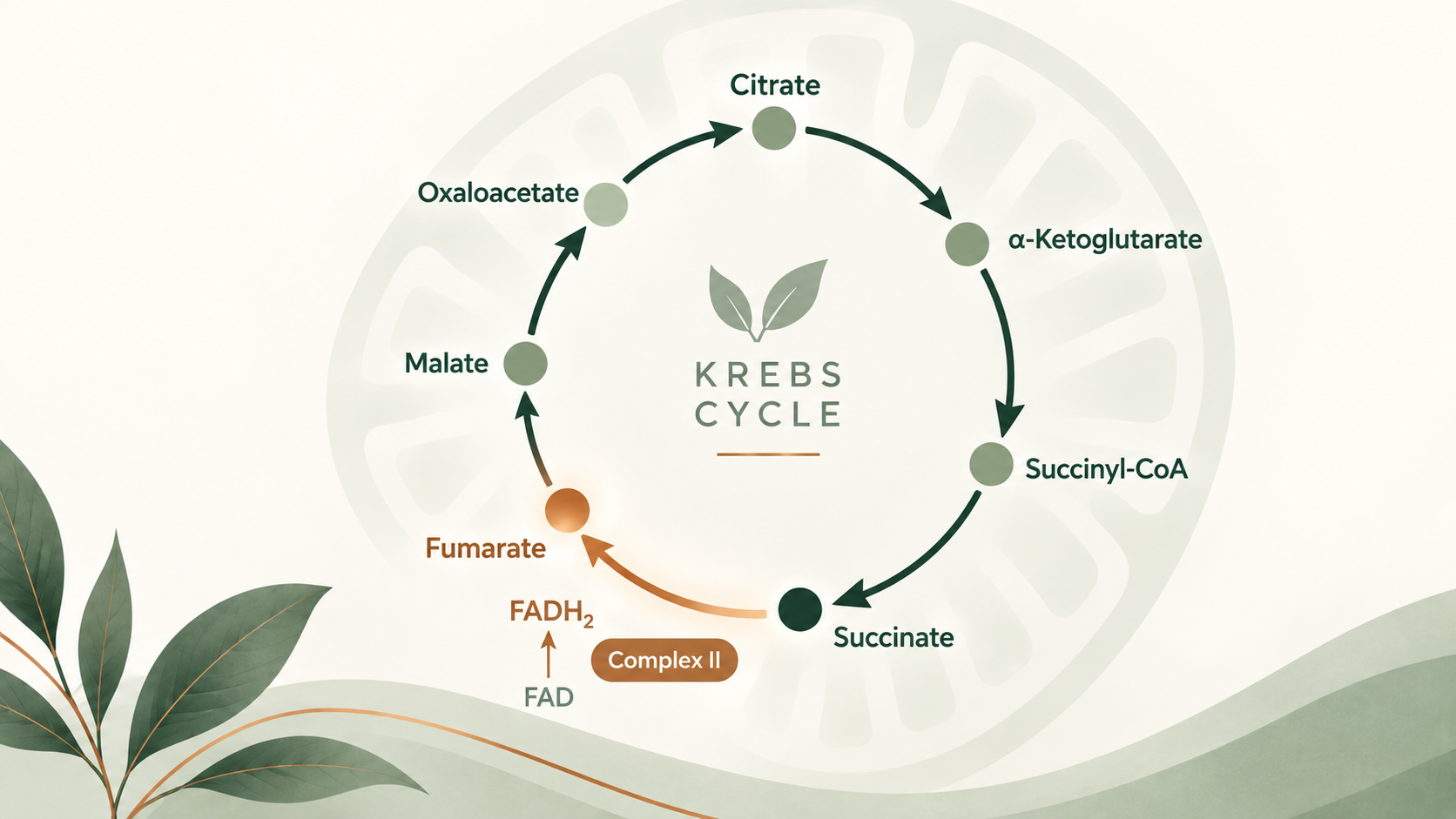
Where It Fits in the Krebs Cycle — and Complex II
In the Krebs cycle, succinyl-CoA becomes succinate, and succinate is then converted into fumarate by an enzyme called succinate dehydrogenase.
Here's what makes this step different from every other step in the cycle: succinate dehydrogenase isn't only a Krebs cycle enzyme. It's also Complex II of the electron transport chain. One enzyme, two jobs. That's the handoff — succinate is the exact spot where carbon metabolism physically hands electrons over to the machinery that produces cellular energy.
Because of that dual role, a slowdown here doesn't stay contained to one small corner of metabolism. It can ripple in both directions — backward into the Krebs cycle, and forward into the electron transport chain.
What an Elevated Value May Suggest
When succinate is elevated, carbon is arriving at Complex II, but the electrons aren't clearing downstream the way they should. In broad terms, that usually points toward something slowing the handoff itself, or a backup further along the electron transport chain that's causing succinate to pile up behind it.
That's genuinely useful information — it tells you where to look. It doesn't, on its own, tell you why. An elevated succinate value is a clue pointing at a specific location in mitochondrial metabolism, not a finished diagnosis. Figuring out what's actually causing the slowdown is where the real interpretation work — and the real skill-building — begins.
A Common Interpretation Mistake
The most common mistake with this marker is treating an elevated value as if it explains itself. It's tempting to see "succinate high" and jump straight to a conclusion, or straight to a supplement. But a single number at this one step doesn't tell you the full story — it tells you where the story is happening. Reading it well means looking at what's happening around it, not just at it.
Clinical Pearl
When you see an elevated succinate value, resist the urge to treat it as a standalone finding. Ask what else on the report might be pointing toward the same handoff point. Don't interpret the marker — interpret the marker in the patient. A number on a page is a metabolite name, not a diagnosis on its own.
Conclusion
Succinic acid is a small marker with an outsized job: it marks the exact spot where fuel metabolism hands off to the electron transport chain. On its own, an elevated value tells you that handoff may be slowing or backing up — a real, useful clue. Learning to take that clue further, and turn it into a genuine pattern, is where Organic Acids interpretation gets interesting.
Want to Learn How to Take a Clue Like This One Further?
The Organic Acids Course walks you through the deeper pattern-recognition framework behind markers like succinate — so a single clue becomes a real, actionable interpretation.
Explore the Organic Acids Course