NEUROTRANSMITTERS & BRAIN CHEMISTRY
HVA and VMA: What These Organic Acids Markers Can Tell You About Catecholamine Metabolism
Why HVA and VMA Matter
HVA and VMA are two of the most commonly discussed markers on the neurotransmitter section of an Organic Acids Test — and two of the most commonly misread. Neither one is a direct measurement of brain chemistry. They're downstream urinary metabolites, and their real value lies in what they suggest about catecholamine metabolism moving through the body.
What HVA Broadly Reflects
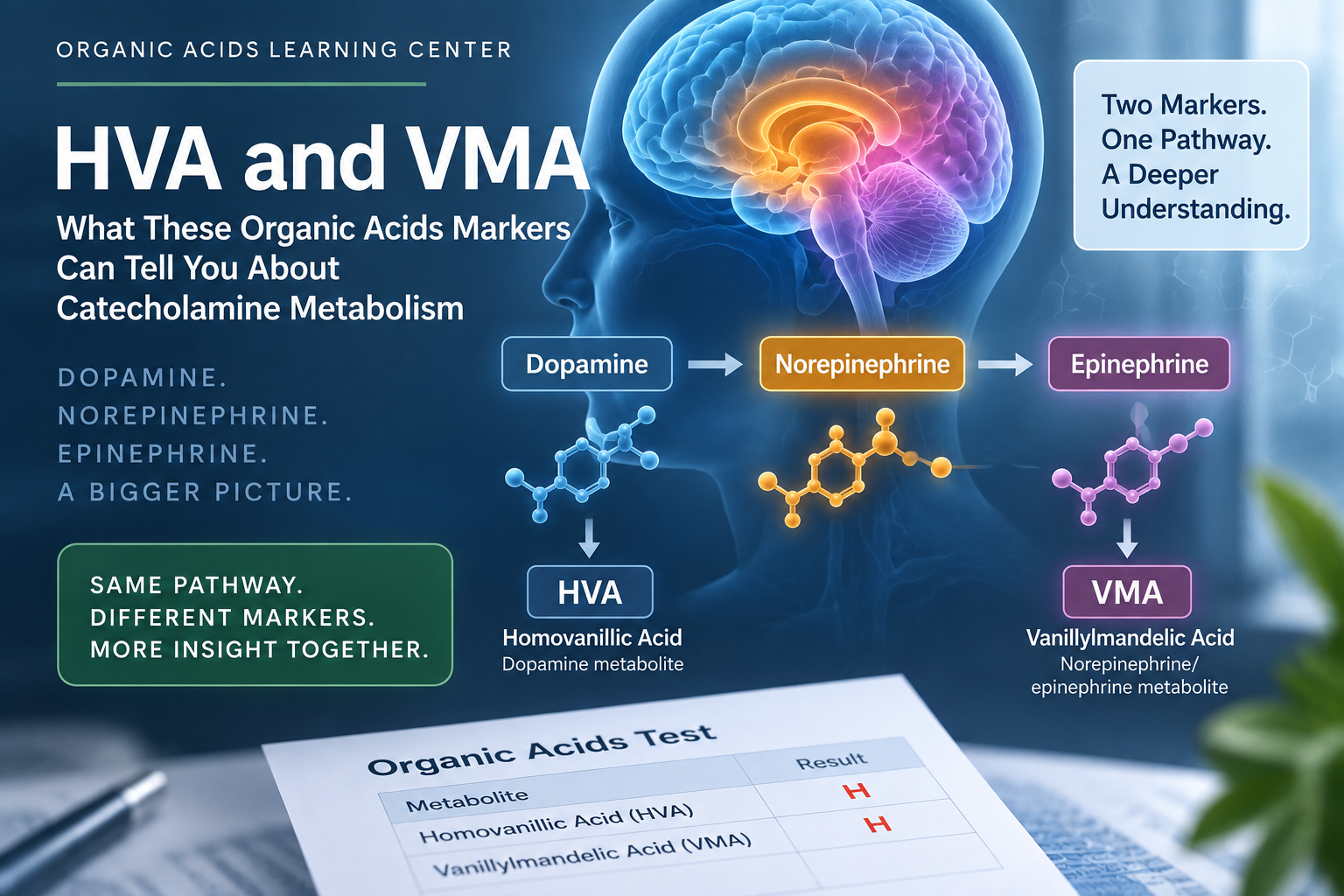
HVA (homovanillic acid) is a downstream metabolite of dopamine. In broad terms, it gives you a window into dopamine turnover and the metabolic activity around that pathway.
What VMA Broadly Reflects
VMA (vanillylmandelic acid) is a downstream metabolite further along the same general pathway, reflecting norepinephrine and epinephrine turnover instead. It's telling you about a different, later stage of catecholamine metabolism than HVA is.
Why the Relationship Between Them Matters More Than Either Alone
Dopamine doesn't stay dopamine — under normal conditions, it continues on to become norepinephrine. That means HVA and VMA aren't really two unrelated numbers; they're two checkpoints along the same road. Looking at how they relate to each other — rather than asking "is HVA high?" or "is VMA low?" in isolation — tells you something neither marker can tell you by itself: whether metabolism is flowing smoothly from one stage to the next, or whether something along that road is worth a closer look.
A Common Interpretation Mistake
The most common mistake is treating an abnormal HVA or VMA value as if it points straight to a specific diagnosis, without stepping back to ask what else might explain it. Before you call a metabolite pathological, check the medication list — certain medications and supplements can shift these markers on their own, and that possibility deserves a look before anything else.
Clinical Pearl
Don't interpret the marker; interpret the marker in the patient. HVA and VMA are far more useful read together, as a relationship, than read as two separate line items — and what that relationship might mean for a specific person is a bigger question than either number can answer alone.
Conclusion
HVA and VMA are useful precisely because they're connected, not because either one stands alone. Learning to read them as two checkpoints on the same pathway — rather than two isolated facts — is a small shift in thinking that changes how much a neurotransmitter section can actually tell you.
Want to Learn How to Read Markers Like This as Part of a Real Framework?
The Organic Acids Course walks you through the deeper pattern-recognition framework behind markers like HVA and VMA — so a single value becomes a real, actionable interpretation instead of a guess.
Explore the Organic Acids Course