Books & Guides / New Book
Is It Mold, Lyme, Parasites, or Long COVID? When Symptoms Overlap and Answers Are Hard to Find
By Dr. Gail Clayton, DCN, CNS, MS, RPh, LDN, and Dr. Margaret Christensen, MD
You wake up exhausted, even after a full night's sleep. Your mind feels foggy, your joints ache, and foods you've eaten for years suddenly seem to cause problems.
Some days, your heart races for no obvious reason. Other days, you feel reasonably well—until something triggers another wave of symptoms.
You've seen several healthcare professionals. You've had blood tests, perhaps received a diagnosis or two, and tried different approaches to feel better.
But something still doesn't add up.
What if the problem isn't that you're missing one diagnosis? What if several different conditions can produce similar symptoms—and sometimes more than one factor is involved?
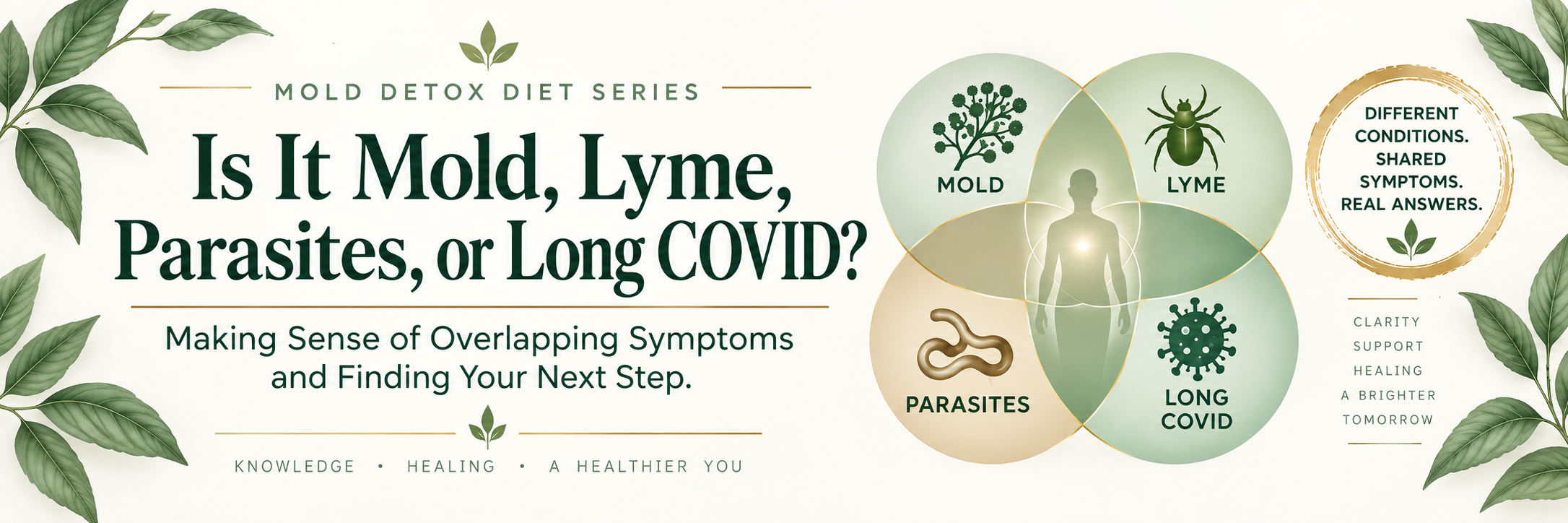
This is the question behind our new book, Is It Mold, Lyme, Parasites, or Long COVID? Making Sense of Overlapping Symptoms and Finding Your Next Step.
Four Different Conditions. Surprisingly Similar Symptoms.
Mold-related health concerns, Lyme disease, certain parasitic infections, and Long COVID are different conditions with different causes.
Yet people investigating these conditions often describe remarkably similar experiences.
Fatigue that doesn't improve with rest. Difficulty concentrating. Digestive disturbances. Headaches. Muscle and joint discomfort. Sleep problems. Changes in exercise tolerance. Unusual sensitivities.
These symptoms are not unique to any one diagnosis.
That's part of what makes the search for answers so challenging.
A person experiencing brain fog and fatigue after COVID-19 may have symptoms resembling those reported by someone investigating Lyme disease. Digestive complaints and immune-related symptoms may occur in several other conditions as well.
And someone living in a water-damaged building may be dealing with environmental concerns that deserve investigation alongside other possible explanations.
Similar symptoms don't necessarily mean the same underlying problem.
Understanding that distinction is one of the most important steps toward asking better questions.
Why Looking at One Body System May Not Tell the Whole Story
Our bodies don't operate as collections of independent organs.
The immune system communicates with the nervous system. The digestive tract influences immune activity. Hormones help regulate metabolism and energy. Mitochondria provide the energy that cells need to function.
When one system is under stress, others may be affected.
Imagine a house where several lights begin flickering.
You could replace each lightbulb individually. But if the underlying problem involves the electrical supply, replacing bulbs won't explain why the problem keeps returning.
The body is considerably more complex, of course. But the analogy illustrates why it can be helpful to look for connections rather than treating every symptom as an isolated event.
At the same time, not every symptom shares a common cause. Sometimes several separate health problems occur together.
The challenge is learning how to investigate without making assumptions too early.
Mold, Lyme, Parasites, and Long COVID: Where Do They Connect?
Researchers and clinicians continue studying how infections, environmental exposures, immune signaling, cellular energy, and inflammation interact.
Some of these relationships are well established. Others remain areas of emerging research or clinical investigation.
Consider a few examples.
Mold and water-damaged buildings
Damp indoor environments are associated with recognized respiratory and allergic health effects. Environmental medicine clinicians also investigate broader symptom patterns in selected patients, although the causes and diagnostic approaches remain subjects of study.
Lyme disease
This tick-borne infection can affect multiple body systems. Symptoms that persist after treatment require careful evaluation, including consideration of other conditions that could explain ongoing difficulties.
Parasitic infections
Different parasites affect the body in different ways. Some involve the digestive tract, while others can cause systemic symptoms. Accurate diagnosis depends on the specific organism and clinical circumstances.
Long COVID
Some people experience persistent or recurring symptoms following SARS-CoV-2 infection, including fatigue, cognitive difficulties, and exercise intolerance. Researchers are investigating several possible biological mechanisms.
The point isn't that all these conditions share one underlying cause.
It's that overlapping symptoms can make it difficult to recognize which questions need answering first.
And that's where a more thoughtful, organized approach becomes valuable.
Why We Wrote This Book
Through our educational work, we've encountered a recurring challenge: people often have access to tremendous amounts of health information but struggle to understand how the pieces fit together.
One article discusses inflammation. Another focuses on mitochondria. Someone recommends investigating the gut microbiome. Another person suggests mold exposure, Lyme disease, or a past viral infection.
Before long, the possibilities become overwhelming.
We wanted to create a resource that helps readers organize the information rather than adding to the confusion.
Drawing on our backgrounds in clinical medicine, pharmacy, nutritional biochemistry, and health education, we wrote this book to explore the relationships among environmental exposures, infectious conditions, immune responses, and interconnected body systems.
Our goal isn't to convince readers they have mold illness, Lyme disease, parasites, or Long COVID.
It's to help readers understand the questions worth asking, recognize where symptoms overlap, and approach their next steps with greater clarity.
What You'll Discover Inside
In Is It Mold, Lyme, Parasites, or Long COVID?, we explore:
- Why one diagnosis doesn't always explain every symptom.
- How different triggers may involve overlapping biological pathways.
- The role of immune signaling, inflammation, and cellular energy.
- How gut health, the brain, and microbes communicate.
- Why individual susceptibility and cumulative stress can influence how people feel.
- How to begin identifying missing pieces and considering sensible next steps.
The book uses accessible explanations and memorable analogies to make complex science easier to follow.
You don't need a medical degree to understand the discussion.
And you don't need to know exactly what's causing your symptoms before you begin learning how the different pieces may connect.
Knowledge Is a Starting Point, Not the Finish Line
When health questions become complicated, it's tempting to search for one more test, one more supplement, or one more explanation.
But understanding your health often begins with something simpler: collecting good information, recognizing patterns, and learning which questions deserve further investigation.
That's also the philosophy behind our educational work at Mold Detox Diet.
Our Learning Center offers articles on mold exposure, mast cells, immune function, cellular energy, gut health, and recovery.
Our Books & Guides collection provides additional opportunities to explore specific topics at your own pace.
And for those who want structured education, ongoing guidance, and a supportive learning community, we're developing Mentored Healing. Enrollment is opening soon, and interested readers can join the waitlist.
Different people will need different kinds of support.
The important thing is to start with a clearer understanding of the possibilities rather than feeling pressured to chase every possible explanation at once.
Ready to Start Connecting the Dots?
If you've ever wondered whether your symptoms could be related to mold exposure, Lyme disease, parasites, Long COVID, or something else entirely, we wrote this book with readers like you in mind.
Is It Mold, Lyme, Parasites, or Long COVID? Making Sense of Overlapping Symptoms and Finding Your Next Step is our invitation to look at the bigger picture.
Not to jump to conclusions.
Not to assume every symptom has one cause.
But to become a more informed advocate for your health.
Adapt • Adjust • Continue.
Kindle edition coming soon. The Amazon purchase link will be added once the book is available.
Educational Disclaimer
This article is provided for educational and informational purposes only. It is not intended to diagnose, treat, cure, or prevent any disease and is not a substitute for individualized medical advice, diagnosis, or treatment. Consult a qualified healthcare professional about your symptoms and medical decisions.
Connect, Learn & Grow With Us
Join our professional communities and follow along for ongoing education from Drs. Christensen and Clayton.
Professional Profiles
Dr. Margaret Christensen on LinkedIn →
Professional updates, functional medicine perspectives, and clinical education.
Dr. Gail Clayton on LinkedIn →
Articles on organic acids interpretation, functional biochemistry, and clinical nutrition.
Communities
Toxic Mold — with Dr. Gail Clayton (Facebook group) →
For anyone interested in mold illness, environmental exposures, and recovery education. Ask questions and learn alongside others.
Organic Acids Interpretation Support (Facebook group) →
For practitioners who want to discuss organic acid interpretation, case patterns, and related educational topics with colleagues.
Video & Updates
Webinars and videos on mold illness, detoxification, and recovery.
Teaching videos on organic acids and functional biochemistry.
News, new articles, and upcoming education.