GUT & MICROBIAL MARKERS
Arabinose vs. D-Arabinitol: Why These Two Gut Markers Can Tell Different Stories
Why These Two Markers Are Commonly Confused
Different labs report different "yeast markers" on an Organic Acids Test — and it's easy to assume they're all measuring the same thing. Both arabinose and D-arabinitol get filed under "fungal" or "yeast" sections, both are sugar-related compounds associated with Candida, and both show up as a flagged red value when something's off. That surface-level similarity makes it tempting to treat them as interchangeable. They aren't.
A Simple Explanation of the Difference
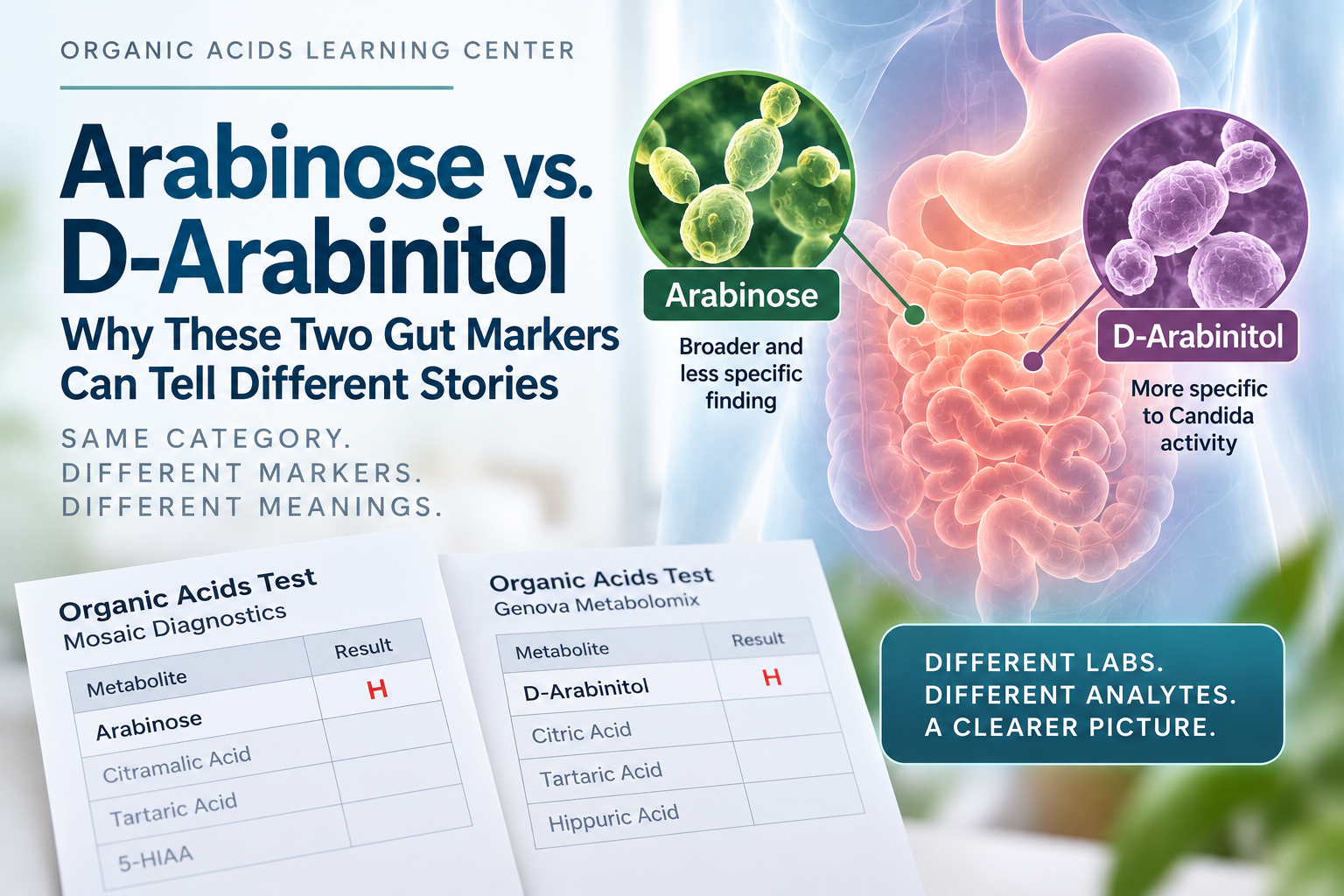
Arabinose and D-arabinitol are distinct molecules. D-arabinitol is a metabolite associated more specifically with Candida activity, while arabinose is a broader and less specific finding — one that can be influenced by diet, other microbial activity, or general intestinal dynamics, not Candida specifically. Similar-sounding names, similar-looking sections on a report, genuinely different biology underneath.
Why This Matters When Comparing Labs
This becomes a real problem when a patient brings in reports from two different laboratories and one flags "yeast" while the other doesn't. It's tempting to treat that as a disagreement between labs — but often, the two reports simply didn't measure the same analyte in the first place. One may have measured arabinose; the other, D-arabinitol. That's not a contradiction to resolve. It's a reason to check what was actually tested before drawing any conclusion at all.
A Common Interpretation Mistake
The most common mistake is treating an elevated arabinose value as if it means the same thing as an elevated D-arabinitol value. They are not interchangeable markers, and a flagged result on one lab should not automatically be compared directly with a differently named "yeast marker" on another report.
Clinical Pearl
When two laboratories seem to disagree, first ask whether they measured the same metabolite. Only after that's settled does it make sense to ask which result actually fits the patient in front of you. Don't interpret the marker; interpret the marker in the patient.
Conclusion
Arabinose and D-arabinitol may sit in the same section of a report, but they're not the same story. Knowing the difference is what keeps a borderline, non-specific flag from becoming an unwarranted diagnosis — and it's exactly the kind of distinction that makes lab comparison a skill worth learning properly, not guessing at.
Want to Learn How to Compare Findings Across Labs?
The Organic Acids Course walks you through the deeper pattern-recognition framework behind markers like these — so a flagged value becomes a real, actionable interpretation instead of a guess.
Explore the Organic Acids Course