DETOXIFICATION & OXIDATIVE STRESS
Recognizing Oxidative Stress on an Organic Acids Test
Why Oxidative-Stress Markers Matter
Free radicals aren't the enemy. They're a normal part of how the body produces energy, fights infection, and detoxifies. The clinically important question isn't whether free radicals exist — they always do — it's whether antioxidant defenses are keeping pace with how many are being generated.
Oxidative-stress markers on an Organic Acids Test give you a window into that balance. They don't tell you something is "broken." They tell you whether demand and reserve are currently in sync.
Oxidative Demand vs. Antioxidant Reserve
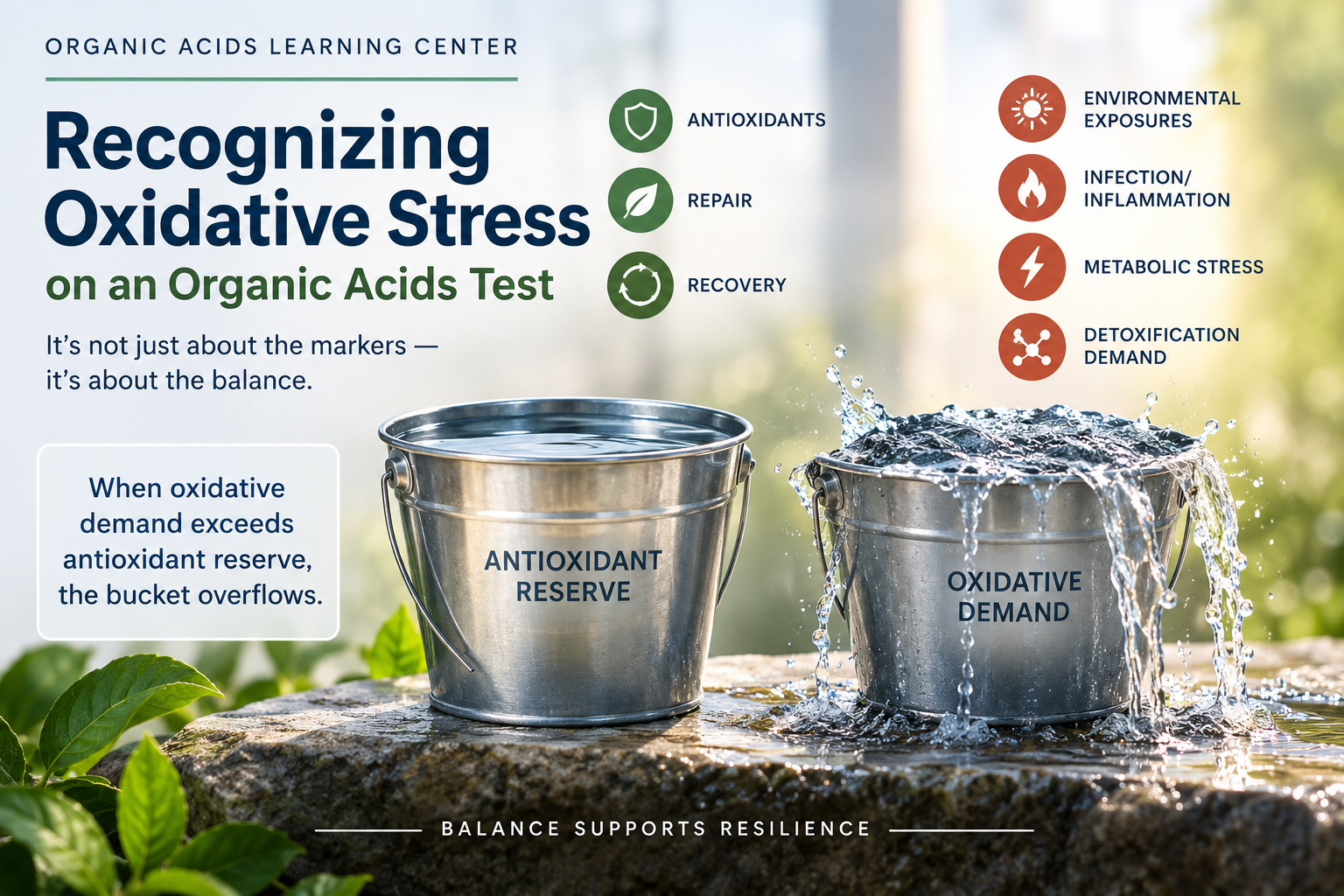
Think of it like a bucket. A person can tolerate a fair amount of oxidative insult while their antioxidant defenses compensate — the bucket holds. Symptoms and abnormal patterns tend to show up when cumulative burden exceeds what that reserve can absorb — the bucket overflows.
Nothing about this is static. Antioxidant capacity isn't a fixed number you either have or don't; it's an ongoing balance between how much oxidative demand the body is facing and how well its reserve is keeping up with that demand over time.
One Abnormal Marker Is a Clue, Not a Diagnosis
A single abnormal oxidative-stress marker can be useful, but it rarely tells the whole story on its own. It's a clue pointing toward a broader question — whether redox balance is under pressure — not a standalone finding you can read in isolation and act on with confidence.
A Common Interpretation Mistake
The most common mistake is seeing an elevated oxidative-stress marker and reaching straight for a bigger antioxidant supplement, without asking why the demand is elevated in the first place. Before adding more antioxidants, ask what is consuming them. More antioxidants without that answer is treating the symptom of an imbalance, not the imbalance itself.
Clinical Pearl
Remove the drain before trying to refill the antioxidant reservoir. Many different things can increase oxidative demand — the point isn't to guess at which one applies here, it's to recognize that finding and addressing the source matters more than simply adding more antioxidant support on top of an ongoing drain.
Conclusion
An oxidative-stress marker on an Organic Acids Test is a signal, not a sentence. It tells you the body may be working harder than its reserve can comfortably support — and that's a starting point for asking better questions, not a finished answer.
Want to Learn How to Read Markers Like This as Part of a Real Framework?
The Organic Acids Course walks you through the deeper pattern-recognition framework behind markers like these — so a single clue becomes a real, actionable interpretation instead of a guess.
Explore the Organic Acids Course