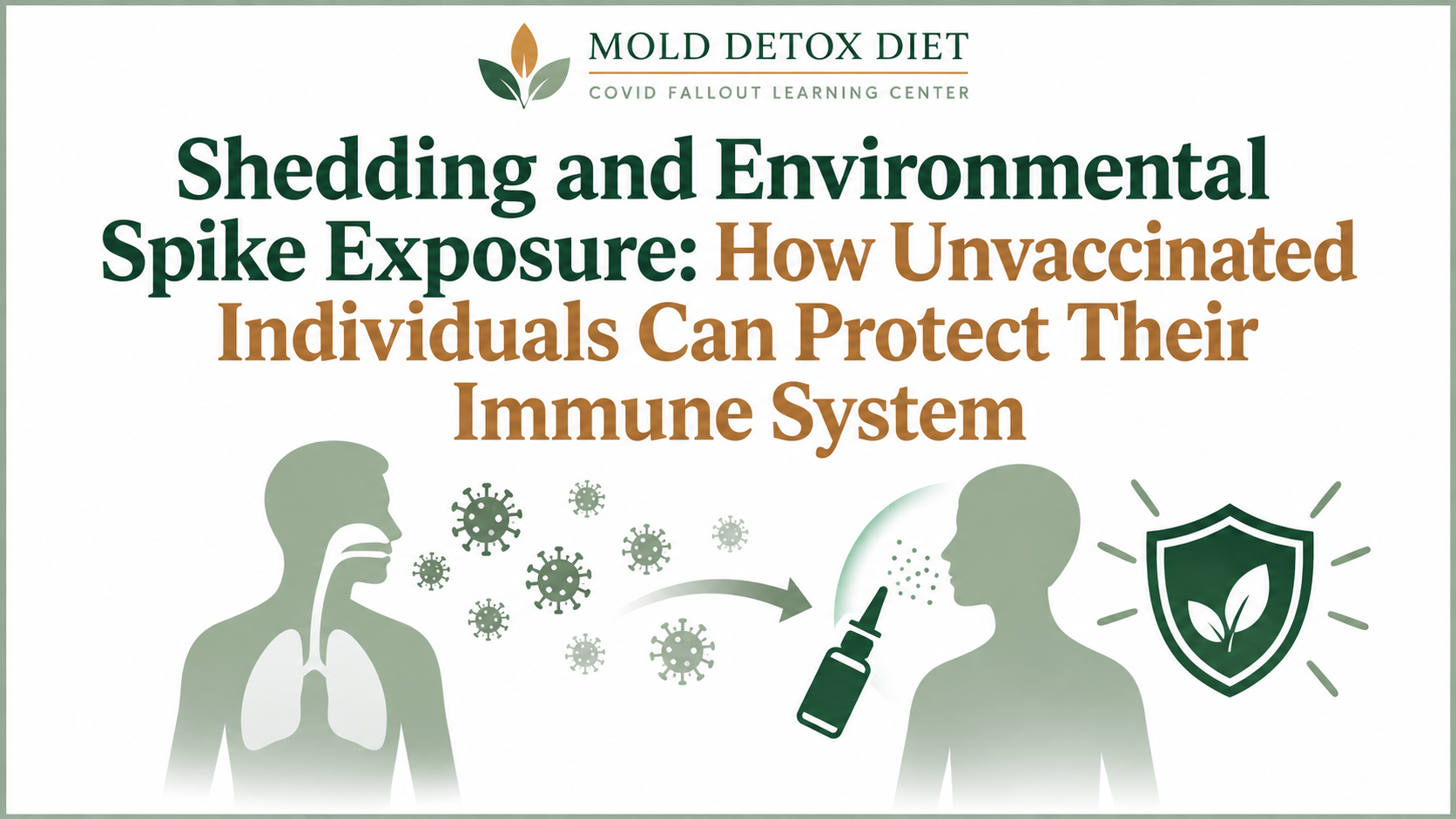
Shedding and Environmental Spike Exposure: How Unvaccinated Individuals Can Protect Their Immune System
By Dr. Margaret Christensen and Dr. Gail Clayton
This article presents the clinical perspectives and educational approaches discussed by Dr. Margaret Christensen and Dr. Gail Clayton during their COVID Fallout Summit and follow-up Q&A sessions.
Many unvaccinated individuals report developing sudden fatigue, headaches, irregular menstrual cycles, or inflammatory flares after being in close proximity to recently vaccinated individuals or after intimate contact. Questions submitted during our Q&A sessions frequently ask: "Is spike protein shedding real, and how can unvaccinated people protect themselves?"
To address these concerns, Dr. Margaret Christensen and Dr. Gail Clayton evaluate the clinical concept of secondary spike exposure—how viral spike proteins, exosomes, and lipid nanoparticles may transmit environmentally, and how non-vaccinated individuals can fortify their immune defenses.
What Is Environmental Spike Exposure ("Shedding")?
In conventional medicine, the term "shedding" traditionally refers only to live, attenuated viruses shedding from a vaccine. However, in post-COVID functional medicine, clinicians use the term to describe secondary exposure to active spike protein fragments or genetic messaging molecules.
Dr. Christensen and Dr. Clayton discuss several proposed mechanisms for environmental transmission:
Exosomal Transport: Research demonstrates that cells producing spike protein package these fragments into microscopic extracellular vesicles called exosomes. Exosomes are stable biological packages released in sweat, breath, saliva, and bodily fluids, allowing intercellular and potential person-to-person transfer.
Lipid Nanoparticle Durability: Synthetic lipid nanoparticles (LNPs) carrying mRNA code are designed for durability and systemic circulation, potentially persisting in secretions longer than initially assumed.
"Spike Magnets": Certain sensitive individuals—particularly those living with partners who recently received mRNA injections or work in high-exposure environments—show heightened susceptibility to secondary spike reactions. Clinicians refer to these sensitive individuals as "spike magnets".
Mucosal Barrier Protection: Nasal Rinses and Spray Protocols
Because airborne spike fragments and exosomes enter primarily through the nasal passages and upper respiratory tract, protecting mucosal membranes is a critical first line of defense:
Iodine Nasal Rinses & Sprays: Clinicians emphasize Povidone-Iodine or Lugol's iodine nasal sprays and gargles. Iodine exhibits broad antiviral and protein-deactivating properties, helping neutralize incoming spike fragments on contact. (Note: A Lugol's skin patch test can help evaluate baseline iodine status).
Nebulized Hydrogen Peroxide: Following protocols such as Dr. David Brownstein's, nebulizing diluted food-grade hydrogen peroxide with saline helps clear respiratory tissue and reduce viral or exosomal burden in the sinuses.
Mucosal Proteolytic Barrier: Using oral sinus washes containing natural antimicrobial extracts (such as Biocidin) helps maintain a healthy sinonasal microbiome and clear mucosal inflammation.
Practitioner Protocol on Fullscript
Mucosal Barrier Protocol: Basic Immune Support
These supplement collections are curated educational resources. Purchases made through our Fullscript dispensary may provide compensation to our practice. Supplements are not substitutes for individualized medical care.
Systemic Defense and Environmental Hygiene
When environmental exposure or intimate contact cannot be avoided, systemic immune fortification helps prevent spike fragments from triggering mast cell flares or micro-clots:
Proteolytic Spike Protectors: Taking fibrinolytic enzymes (Nattokinase, Bromelain, or Serrapeptase) helps break down circulating spike debris before it can bind to nicotinic or ACE2 receptors.
Targeted Binding Agents & Antioxidants: N-Acetyl Cysteine (NAC) (500–600 mg) provides key antivenom and spike-binding support while boosting cellular glutathione.
Physical Barriers & Masking: For high-exposure environments or crowded indoor settings, wearing an N95 mask provides a physical barrier against airborne particulate droplets carrying exosomes.
Immune Fortification: Daily baseline support with Vitamin D3/K2, Zinc, Quercetin (mast cell stabilizer), and Melatonin helps reinforce baseline immune cell resilience.
Safety Precautions and Clinical Considerations
Protecting against environmental spike exposure requires balance to avoid overburdening the liver or triggering histamine reactions:
Intimate Contact Protocols: Unvaccinated individuals with vaccinated partners who experience post-exposure flares may benefit from continuous low-dose enzyme support (such as 1/4 nicotine patch protocols or daily Nattokinase).
Avoiding Over-Detoxification: Patients with Mast Cell Activation Syndrome (MCAS) must introduce binding agents and enzymes slowly to prevent severe dumping reactions or hives.
Summary
Environmental spike exposure ("shedding") is understood in functional medicine as the transfer of spike fragments or exosomes through breath, sweat, and bodily fluids. Unvaccinated individuals can protect their health by reinforcing mucosal barriers with iodine nasal rinses, taking oral proteolytic enzymes, and fortifying systemic immunity with Vitamin D, Zinc, and NAC.
Frequently Asked Patient Questions
1. Does an N95 mask help protect unvaccinated individuals from spike protein shedding in public?
Yes. An N95 mask filters airborne droplets and fine particulate matter that may carry exosomes or spike protein fragments in crowded indoor environments.
2. How can I protect myself during intimate contact or sexual intercourse with a vaccinated partner?
Clinicians suggest using pre- and post-contact mucosal protection (iodine nasal spray and oral gargles), alongside daily systemic spike protectors like Nattokinase, NAC, and Quercetin to reduce sensitivity to transferred fluids.
3. What is the difference between Lugol's iodine and the iodine used in CT imaging?
Lugol's iodine is an elemental nutritional supplement used for immune and thyroid support, whereas CT imaging contrast is a synthetic chelated iodine dye used strictly for X-ray visualization. CT contrast dyes cannot be used as nutritional or mucosal sprays.
Source Materials & References:
Dr. Jill Crista, Long Haul Protocol Notes on Nicotinic Receptors & Spike Magnets [2–6].
Front Line COVID-19 Critical Care Alliance (FLCCC) Secondary Exposure & Prevention Protocols.
Dr. Margaret Christensen & Dr. Gail Clayton, COVID Fallout Summit & Educational Q&A Transcripts.
More in Spike Protein, Vaccine Injury & Neutralization Protocols
Go Deeper
Mold, Mast Cells, & Autoimmunity — our in-depth course on immune modulation, mast cells, and biotoxin illness mechanisms.
Explore all of our educational courses
Mentored Healing — enrollment opening soon. Join the waitlist for guided education and community support.
The information in COVID Fallout Resources is for educational purposes only and is not intended as medical advice. Please consult a qualified healthcare provider about your individual situation before starting, stopping, or changing any supplement, medication, or protocol.