CASE STUDIES & CLINICAL PEARLS
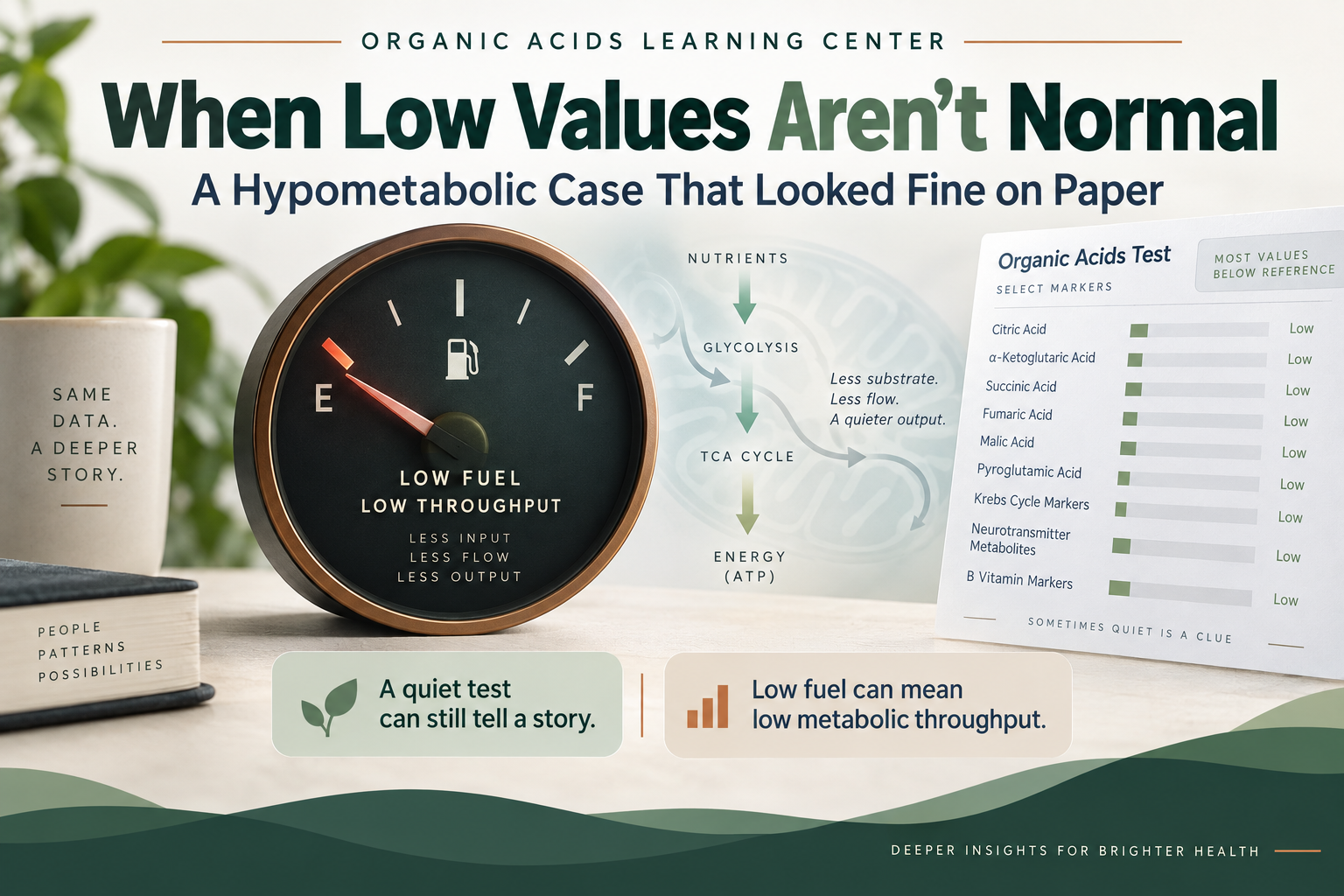
When Low Values Aren't Normal: A Hypometabolic Case That Looked Fine on Paper
Why Low Values Can Be Misleading
It's natural to look at an Organic Acids Test and feel reassured when nothing is flagged high. No red markers, nothing dramatic — surely that means metabolism is running smoothly.
But a pathway can fail by running too quietly, not just by running too loudly. When there isn't enough substrate moving through a pathway in the first place, the metabolites that would normally show up as elevated simply never accumulate. The absence of a high flag isn't proof that everything is working — sometimes it's a sign that not enough is moving through to produce one.
What a Quiet, Low-Pattern OAT May Suggest
When low values show up broadly across several sections of the report, it can suggest reduced metabolic throughput — a pattern where multiple pathways may not be receiving enough fuel to keep moving normally. It's not one marker telling a story on its own; it's a pattern across the whole report worth noticing.
Why Low Substrate Delivery Matters
Metabolic pathways run on a steady supply of raw material. What a patient eats is not the same as what reaches the pathway — there are steps in between, and if something along that path isn't working well, the pathway downstream can look quiet simply because it isn't receiving enough to work with.
A Common Interpretation Mistake
The most common mistake is scanning a report only for high values, and treating an unremarkable or "normal" result as proof that nothing is wrong. A marker can sit in a normal range not because the pathway is healthy, but because there isn't enough substrate reaching it to push the number higher in the first place.
Clinical Pearl
Before calling it mitochondrial disease, ask where the fuel got lost. A broadly low, quiet-looking report is a reason to look upstream at what's reaching the pathways — not a reason to assume the engine itself is broken.
Conclusion
A quiet Organic Acids Test is still data. Don't interpret the marker; interpret the marker in the patient — and remember that low values, read together, can tell a story just as important as any high one.
Want to Learn How to Read a Full Report as a Connected Pattern?
The Organic Acids Course walks you through the deeper pattern-recognition framework behind reports like these — so a quiet page becomes a real, actionable interpretation instead of a false reassurance.
Explore the Organic Acids Course