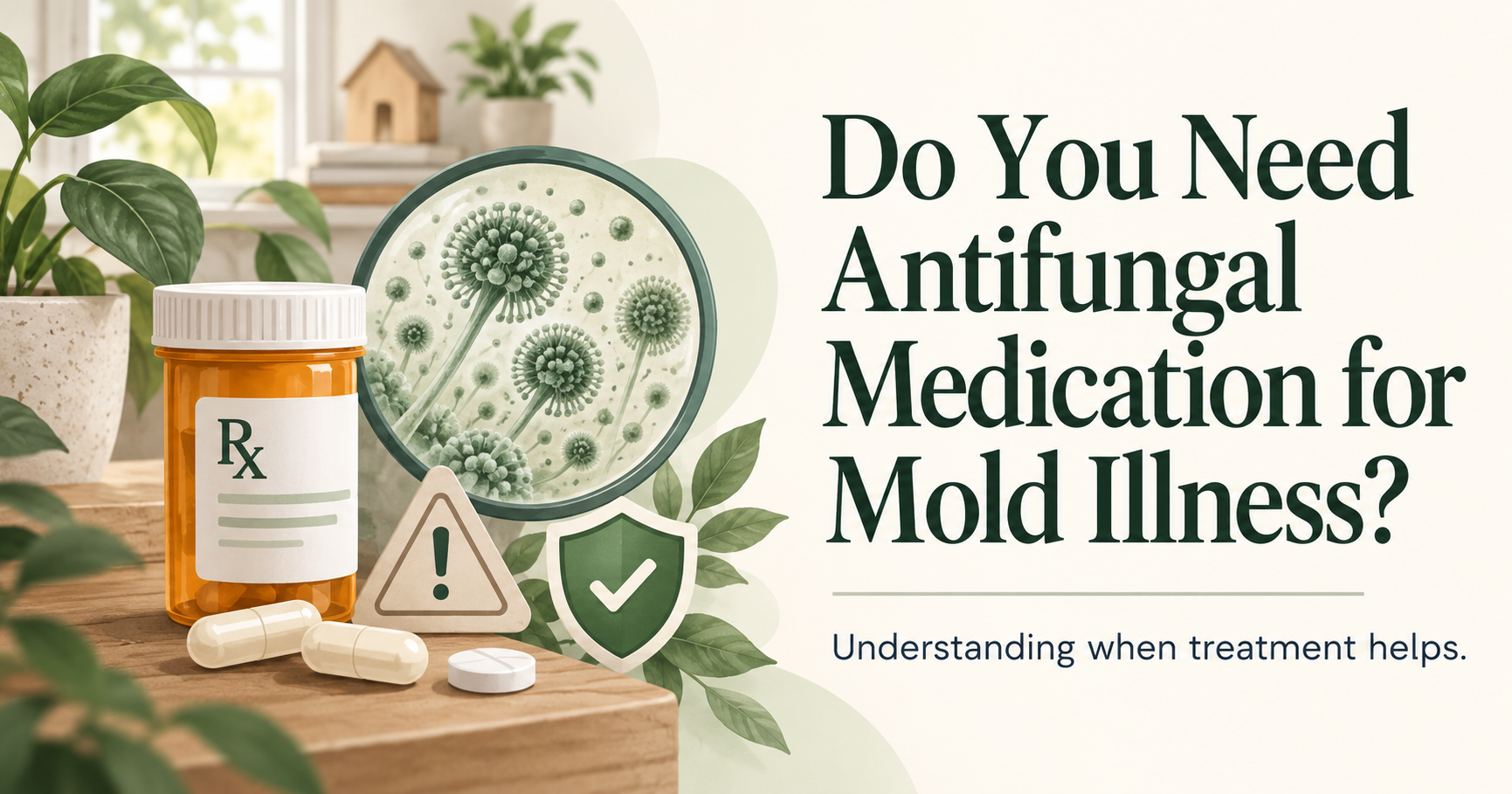
Do You Need Antifungal Medication for Mold Illness?
Understanding When Treatment Helps
Why mold exposure, fungal colonization, and fungal infection are not the same—and why the right treatment depends on understanding the difference.
By Dr. Gail Clayton, DCN, CNS, MS, RPh, LDN, and Dr. Margaret Christensen, MD
You’ve discovered mold in your home. Perhaps you’ve been experiencing fatigue, respiratory problems, headaches, brain fog, or other unexplained symptoms.
After researching mold-related illness, you encounter information about medications such as fluconazole, itraconazole, nystatin, and amphotericin B.
Naturally, you begin wondering:
If mold is a fungus, shouldn’t an antifungal medication help me recover?
It’s a reasonable question. However, the answer is more complicated than it first appears.
Antifungal medications are valuable treatments for certain fungal infections.[1] But they are not automatically appropriate for someone who has been exposed to mold or who suspects a mycotoxin-related illness.
Understanding the difference can help you avoid unnecessary medication risks while making more informed decisions with your healthcare professional.
First, Understand the Difference Between Mold Exposure and Fungal Infection
The word mold describes many different types of fungi that naturally occur in our environment.
We encounter fungal spores in outdoor air, soil, food, and indoor spaces throughout our lives.
Most of these encounters do not result in fungal infections.
However, damp or water-damaged buildings may support excessive mold growth, and exposure can contribute to recognized health problems, particularly among susceptible individuals.
These include allergic reactions, asthma symptoms, and respiratory irritation.[2]
To understand whether antifungal medication might be useful, we first need to distinguish four different situations.
1. Mold Exposure
Mold exposure occurs when someone breathes in fungal spores, fragments, or other materials present in the environment.
A person living in a water-damaged home may experience respiratory or allergic symptoms without having a fungal infection.
In this situation, the priority is to identify and correct moisture problems, address contaminated materials appropriately, and evaluate the person’s medical symptoms.
Antifungal medications do not remove mold from a building or eliminate environmental exposure.
2. Mycotoxin Exposure
Some fungi produce secondary metabolites known as mycotoxins.
These compounds differ substantially in their chemistry, toxicology, and routes of exposure.
Certain mycotoxins are well-established health hazards, particularly through contaminated foods.
Scientists are also investigating the possible health effects of inhaling mycotoxins associated with damp indoor environments.
However, exposure to a mycotoxin does not necessarily mean that living fungi are growing inside the body.
Antifungal medications act on susceptible fungal organisms. They do not directly neutralize or remove previously absorbed mycotoxins. Strategies aimed at reducing mycotoxin reabsorption are a separate topic, covered in Mold Detox Binders Explained.
Furthermore, evidence is insufficient to recommend routine systemic antifungal medication for nonspecific symptoms attributed to indoor mycotoxin exposure in the absence of a diagnosed or strongly suspected fungal disease.
3. Fungal Colonization
Colonization means fungi are present on or within a body surface without necessarily causing tissue damage or a clinically significant infection.
For example, Candida species may normally be found in the mouth, digestive tract, or vaginal environment.
Likewise, fungi may sometimes be detected in respiratory samples without representing invasive disease.[3]
The significance depends on the organism, location, symptoms, immune status, and other clinical findings.
A positive fungal test does not automatically establish that medication is needed.
4. Fungal Infection
A fungal infection occurs when fungal organisms cause disease in tissues or organs.
Examples include oral candidiasis, certain vaginal yeast infections, fungal skin infections, chronic pulmonary aspergillosis, and invasive fungal disease.[3,4]
Some infections are relatively straightforward to treat. Others can be serious or life-threatening.
When a clinically significant fungal infection is present, correctly selected antifungal medication may be essential.
The important question is not simply whether a fungus has been detected.
The important question is whether a fungal organism is causing disease that requires treatment.
When Are Antifungal Medications Appropriate?
Antifungal treatment may be appropriate for several established medical conditions.
Candida Infections
Candida is a group of yeasts that can sometimes cause infections, particularly when normal microbial defenses are disrupted or when a person has specific medical risk factors.
Examples include:
Oral thrush
Esophageal candidiasis
Certain vaginal yeast infections
Invasive candidiasis in vulnerable hospitalized patients
Depending on the infection, treatment may include topical medications, oral antifungals, or intravenous therapy.[3]
However, finding Candida in a stool sample does not necessarily establish that Candida is causing a person’s gastrointestinal symptoms. Candida is commonly detected in the stool of healthy people.[5]
Aspergillus Infections
Aspergillus is a widespread environmental mold.
Most healthy people inhale Aspergillus spores without developing a serious infection.
However, some individuals develop Aspergillus-related disease.[4]
These conditions include:
Allergic bronchopulmonary aspergillosis (ABPA): An immune-mediated condition most often associated with asthma or cystic fibrosis. Treatment is individualized and may involve corticosteroids, antifungals, or other therapies.
Chronic pulmonary aspergillosis: A condition that may affect people with certain preexisting lung abnormalities. Antifungal treatment is often used when clinically indicated.
Invasive aspergillosis: A serious infection that can occur in people with significant immune suppression, such as certain transplant recipients or individuals with prolonged neutropenia.
These conditions require medical assessment and, in some cases, specialist care.
Fungal Sinus Disease
Fungi may be involved in several distinct sinus conditions.
Allergic fungal rhinosinusitis differs from invasive fungal sinus infection.
Treatment may involve surgery, anti-inflammatory medications, antifungals in selected cases, or a combination of approaches.[6]
A diagnosis of fungal sinus disease should not be made solely on the basis of nonspecific nasal symptoms or environmental mold exposure.
Why Doesn’t One Antifungal Work Against Every Fungus?
Different fungi have different biological characteristics.
Some medications work well against certain yeasts but have little or no activity against important molds.
Others are used for serious infections involving specific fungal species.[7]
This is one reason selecting the appropriate medication requires more than simply knowing that a patient has encountered mold.
Azoles: Fluconazole, Itraconazole, and Others
Azole antifungals interfere with the production of ergosterol, an important component of fungal cell membranes.
Without adequate ergosterol, susceptible fungi cannot maintain normal membrane function.
Common examples include fluconazole, itraconazole, voriconazole, posaconazole, and isavuconazole.
However, these medications do not have identical activity.
For example, fluconazole is useful against certain Candida infections but does not provide reliable treatment for Aspergillus infections.[4,7]
Some other azoles have activity against Aspergillus and additional molds.
Medication selection depends on the organism, location of infection, disease severity, and patient-specific considerations.
Polyenes: Nystatin and Amphotericin B
Polyenes interact with fungal cell membranes.
Nystatin is commonly used for certain localized Candida infections. Standard oral nystatin preparations are poorly absorbed from the gastrointestinal tract, so they are not used to treat systemic fungal infections.[7]
Amphotericin B, particularly its intravenous formulations, may be used for serious fungal infections when clinically indicated.
These medications differ substantially in how they are absorbed, distributed, and tolerated.
Echinocandins: A Different Target
Echinocandins, including micafungin, caspofungin, and anidulafungin, interfere with production of beta-1,3-glucan, a component of many fungal cell walls.
They are important treatments for certain invasive fungal infections, particularly candidiasis.[3,7]
They are not interchangeable with other antifungal medications and are generally administered intravenously.
This illustrates a basic principle:
The most appropriate antifungal depends on the disease and the organism—not simply on the presence of mold somewhere in the environment.
What About Fungal Biofilms?
Fungal biofilms are organized communities of microorganisms attached to surfaces and surrounded by a protective matrix.
Think of a biofilm as a community of organisms living within a protective neighborhood.
Within this structure, fungi may behave differently than they do as free-floating individual cells.
Biofilms can form on medical devices, including catheters, and may contribute to persistent infections.
Candida biofilms are especially important in certain healthcare-associated infections.
Researchers have shown that biofilm structure and microbial interactions can influence susceptibility to antimicrobial treatment.[8]
However, these findings must be interpreted in context.
Not every patient with chronic symptoms has a clinically significant fungal biofilm, and biofilm-related disease cannot reliably be diagnosed from generalized symptoms alone.
Similarly, although laboratory research has investigated compounds that disrupt fungal biofilms, laboratory effectiveness does not automatically demonstrate safe or effective treatment in humans.
The Human Mycobiome: Not All Fungi Are Harmful
Most people are familiar with the gut microbiome, which includes bacteria that influence digestion, immune signaling, and other aspects of health.
But the microbiome also includes fungi.
The community of fungi associated with the human body is called the mycobiome.
Scientists have identified fungi in several body sites, including the gastrointestinal tract, mouth, and respiratory system.[5]
Some organisms may be harmless under ordinary conditions but become problematic under certain circumstances.
Fungal communities also interact with bacteria and the immune system.
These relationships are complex, and researchers continue to investigate their significance.
One important lesson is that detecting fungi does not necessarily mean that the goal should be to eliminate every fungal organism.
Treatment decisions should consider whether an actual disease process has been identified.
Can Antifungal Medications Cause Problems?
Yes. Like other medications, antifungals can produce adverse effects.
Their risks vary according to the drug, formulation, dose, treatment duration, and health of the person taking them.
Liver Effects
Certain systemic azole medications can affect the liver.
Potential concerns include elevated liver enzymes, medication-induced hepatitis, and, rarely, severe liver injury.[9]
Healthcare professionals may monitor liver function during treatment, particularly when medications are used for extended periods.
Drug Interactions
Some antifungal medications inhibit or interact with cytochrome P450 enzymes.
These enzymes help metabolize many prescription medications.
For example, itraconazole is a strong inhibitor of CYP3A4, an enzyme involved in metabolizing numerous drugs.[7]
Inhibiting CYP3A4 can increase exposure to certain medications, potentially increasing adverse effects.
Other medications or herbal products may reduce antifungal effectiveness by changing drug metabolism.
This is especially important for patients taking multiple prescriptions, supplements, or botanical preparations.
Other Adverse Effects
Depending on the medication, additional concerns may include:
Nausea, vomiting, or diarrhea
Skin reactions
Headaches
Changes in heart rhythm
Kidney injury with certain agents
Effects on medication absorption or metabolism
Some medications require therapeutic drug monitoring to determine whether blood concentrations are adequate and safe.[4,7]
These risks do not mean that antifungals should be avoided when needed.
They mean the potential benefits should outweigh the risks.
Antifungal Resistance: Why More Treatment Isn’t Always Better
Antifungal resistance occurs when fungi become less susceptible or resistant to medications intended to treat them.
This can happen through several biological mechanisms.
Some fungi develop changes in the cellular targets that medications act upon.
Others increase their ability to transport drugs out of fungal cells or activate alternative survival pathways.
Antifungal resistance is a growing global healthcare concern.[10,11]
Unnecessary or inappropriate antifungal exposure may contribute to selection of resistant organisms.
Environmental use of agricultural fungicides can also influence resistance patterns in certain fungi.[10]
Consequently, antifungal stewardship—using the right medication only when indicated, at an appropriate dose and duration—is an important part of healthcare.
Using multiple antifungals without a clear diagnosis is not necessarily more effective and can increase risks.
What About Natural Antifungal Herbs and Supplements?
Many plants produce compounds with antimicrobial or antifungal activity.
Researchers have investigated substances found in oregano, thyme, garlic, cinnamon, berberine-containing plants, and other botanical sources.
Some have demonstrated antifungal effects in laboratory experiments.
However, there is an important difference between inhibiting fungal growth in a laboratory dish and successfully treating an infection in the human body.
In laboratory studies, researchers can expose fungi directly to concentrations of a compound that may not be achievable or safe in living tissues.
Botanical products may also vary substantially in composition and quality.
Potential concerns include medication interactions, gastrointestinal irritation, allergic reactions, and liver toxicity.
Essential oils, in particular, should not be assumed safe for ingestion simply because they have shown antifungal activity in laboratory studies.
Natural products may be scientifically interesting, but they should not replace medically indicated treatment for a serious fungal infection.
What About the Gut Microbiome During Antifungal Treatment?
The gastrointestinal microbiome contains interacting bacterial, fungal, and other microbial communities.
Antimicrobial medications can change this ecosystem.
The degree and clinical importance of these changes depend on the drug, the organism, and the individual.
Researchers are exploring how changes in bacterial communities affect Candida colonization and how fungal communities interact with intestinal immunity.
However, there is not yet sufficient evidence to recommend broad antifungal treatment for nonspecific digestive symptoms solely on the assumption that intestinal fungal imbalance is present.
When digestive symptoms persist, appropriate evaluation may include consideration of medication effects, infections, inflammatory conditions, malabsorption, dietary factors, and other potential causes.
What If You Feel Sick After Mold Exposure but Have No Diagnosed Fungal Infection?
This is where patients often feel confused.
They may have real and persistent symptoms, yet standard testing does not identify an invasive fungal infection.
It is important to recognize that fungal infection is only one possible explanation for symptoms associated with a damp indoor environment.
Depending on the individual, relevant concerns may include respiratory irritation, allergic responses, asthma, sleep disruption, and other medical conditions.[2]
A practical approach includes the following.
Investigate and Correct Moisture Problems
Visible mold and water damage should be addressed promptly and appropriately.
The underlying source of moisture must be corrected, or fungal growth may return.
Evaluate Specific Symptoms
Persistent coughing, wheezing, sinus symptoms, fatigue, digestive concerns, and neurological complaints deserve appropriate assessment.
The goal is to identify conditions that can be diagnosed and treated rather than assuming every symptom originates from a single exposure.
Review Medications and Supplements
Medication side effects and interactions can sometimes contribute to symptoms.
A qualified healthcare professional can help determine whether current treatments may be playing a role.
Support Adequate Nutrition
A varied diet with sufficient protein, vitamins, minerals, and fiber supports normal physiological processes.
Nutritional support can be particularly important when someone has experienced poor appetite, dietary restriction, or chronic digestive symptoms.
However, dietary changes do not replace indicated antifungal treatment for established fungal infections.
Avoid Unnecessary Treatment Escalation
If a treatment has not produced the expected response, that does not automatically mean the dose should be increased or additional medications added.
It may be more useful to reconsider the diagnosis, the medication’s activity against the suspected organism, drug absorption, or whether a different condition is responsible.
Questions to Ask Before Starting an Antifungal Medication
If antifungal treatment is being considered, discussing the following questions with your healthcare professional can help clarify the plan.
What specific fungal infection or condition are we treating?
What findings support the diagnosis?
Why was this particular antifungal selected?
What benefits should we reasonably expect, and when?
What side effects, interactions, or laboratory monitoring should we consider?
How will we determine whether treatment is working?
What is the planned duration of treatment?
These questions encourage shared decision-making and can help prevent unnecessary or prolonged treatment.
Frequently Asked Questions
If I have mold in my house, do I need an antifungal?
Not automatically. Environmental mold exposure does not establish that a person has a fungal infection. Antifungal treatment is generally reserved for specific fungal diseases or other clearly established clinical indications.
Will nystatin remove mycotoxins from my body?
Nystatin acts against susceptible fungi, particularly certain yeasts. It does not directly bind, neutralize, or eliminate mycotoxins. Standard oral nystatin has minimal systemic absorption.
Can fluconazole treat Aspergillus?
Fluconazole does not have reliable activity against Aspergillus. Aspergillus infections may require different medications chosen according to the clinical condition.
Can I have a fungal infection without being immunocompromised?
Yes. Some fungal infections occur in otherwise healthy people, such as skin infections or certain localized yeast infections. However, invasive mold infections are much more common in people with significant immune-system or other medical risk factors.
Do antifungal nasal sprays or sinus rinses help?
It depends on what is being treated. For chronic rhinosinusitis (long-lasting sinus inflammation), a Cochrane review of eight randomized trials, most testing amphotericin B sprays or rinses, found no clear improvement in symptoms or quality of life compared with placebo, and topical antifungals caused more nasal irritation.[12] International sinus guidelines do not recommend routine topical or oral antifungals for chronic rhinosinusitis.[6]
Diagnosed fungal sinus disease is different. Allergic fungal rhinosinusitis is usually managed with sinus surgery and anti-inflammatory treatment, with antifungals considered only in selected cases. Invasive fungal sinusitis is rare but serious, occurs mainly in people with weakened immune systems, and needs urgent specialist care, typically including surgery and intravenous antifungal therapy.[6] If a nasal antifungal has been suggested, ask which diagnosis it is treating and how its effect will be measured.
Are herbal antifungals safer than prescription antifungals?
Not necessarily. Herbal products can cause adverse effects and drug interactions, and many have not undergone the same clinical testing as approved antifungal medications.
If I test positive for Candida, should I treat it?
A positive result does not always indicate a clinically important infection. Interpretation depends on the specimen, symptoms, examination findings, and clinical circumstances. Our articles on SIFO vs. SIBO and yeast-related organic acids markers explain why single results need context.
Can antifungal resistance develop?
Yes. Fungi may acquire or possess resistance to certain medications. Correct selection and appropriate use of antifungals help reduce unnecessary risks.
The Bottom Line: Treat the Condition, Not Simply the Word “Mold”
Mold exposure, mycotoxin exposure, fungal colonization, and fungal infection are different situations.
Although they may involve fungi, they do not all require the same treatment.
Antifungal medications can be highly effective—and sometimes lifesaving—when used for appropriately diagnosed fungal infections.
However, prescribing an antifungal simply because someone has been exposed to mold may not address the source of symptoms and can introduce unnecessary risks.
An individualized approach begins with careful assessment, attention to the indoor environment, and treatment decisions that are supported by the clinical findings.
The goal is not to use the greatest number of interventions.
The goal is to identify what is actually contributing to illness and select the safest, most appropriate response.
Scientific references
- Centers for Disease Control and Prevention. Treating Fungal Diseases with Antifungals. Last reviewed October 24, 2024. CDC.
- World Health Organization. WHO Guidelines for Indoor Air Quality: Dampness and Mould. Geneva: WHO Regional Office for Europe; 2009. Chapter 4: Health effects associated with dampness and mould. Read chapter.
- Pappas PG, Kauffman CA, Andes DR, et al. Clinical practice guideline for the management of candidiasis: 2016 update by the Infectious Diseases Society of America. Clinical Infectious Diseases. 2016;62(4):e1–e50. Read guideline.
- Patterson TF, Thompson GR III, Denning DW, et al. Practice guidelines for the diagnosis and management of aspergillosis: 2016 update by the Infectious Diseases Society of America. Clinical Infectious Diseases. 2016;63(4):e1–e60. Read guideline.
- Nash AK, Auchtung TA, Wong MC, et al. The gut mycobiome of the Human Microbiome Project healthy cohort. Microbiome. 2017;5:153. Read study.
- Orlandi RR, Kingdom TT, Smith TL, et al. International consensus statement on allergy and rhinology: rhinosinusitis 2021. International Forum of Allergy & Rhinology. 2021;11(3):213–739. Read consensus statement.
- Nett JE, Andes DR. Antifungal agents: spectrum of activity, pharmacology, and clinical indications. Infectious Disease Clinics of North America. 2016;30(1):51–83. Read review.
- Fanning S, Mitchell AP. Fungal biofilms. PLoS Pathogens. 2012;8(4):e1002585. Read review.
- Tverdek FP, Kofteridis D, Kontoyiannis DP. Antifungal agents and liver toxicity: a complex interaction. Expert Review of Anti-infective Therapy. 2016;14(8):765–776. Read review.
- Meis JF, Chowdhary A, Rhodes JL, Fisher MC, Verweij PE. Clinical implications of globally emerging azole resistance in Aspergillus fumigatus. Philosophical Transactions of the Royal Society B. 2016;371(1709):20150460. Read review.
- Centers for Disease Control and Prevention. Antimicrobial-Resistant Fungal Diseases. Last updated March 19, 2025. CDC.
- Head K, Sharp S, Chong LY, Hopkins C, Philpott C. Topical and systemic antifungal therapy for chronic rhinosinusitis. Cochrane Database of Systematic Reviews. 2018;(9):CD012453. Read review.
Additional educational source: Tessier L. Thoughtful Use of Antifungals: A Naturopathic Approach. Educational presentation for the International Society for Environmentally Acquired Illness (ISEAI), 2020. Dr. Lauren Tessier’s presentation was used to help identify topics and references; it is cited here as educational context, not as primary research, and the article content was developed independently and checked against the published sources above.
Medical disclaimer
This article provides general education and is not intended to diagnose or treat fungal infections or other medical conditions. Antifungal medications should be used under appropriate medical supervision. Do not begin, change, or discontinue prescription medications without consulting a qualified healthcare professional.
Continue Learning
Learning Center
Explore the Learning Center
Understanding mold-related illness often requires learning how environmental exposure, immune responses, respiratory health, and other physiological processes fit together. Explore the Mold Detox Diet Learning Center for additional articles on mold exposure, testing, inflammation, gut health, and recovery.
Courses
Explore our educational courses
Our Mold Detox Diet educational programs take a broader look at nutrition, environmental health, and the interconnected body systems involved in recovery.
Mentored Healing
Structured education and guidance
If you are looking for structured educational support as you navigate complex health concerns, learn more about Mentored Healing, our guided educational program designed to help you become a more informed advocate for your own health.
Adapt • Adjust • Continue.
Connect, Learn & Grow With Us
Join our professional communities and follow along for ongoing education from Drs. Christensen and Clayton.
Professional Profiles
Dr. Margaret Christensen on LinkedIn →
Professional updates, functional medicine perspectives, and clinical education.
Dr. Gail Clayton on LinkedIn →
Articles on organic acids interpretation, functional biochemistry, and clinical nutrition.
Communities
Toxic Mold — with Dr. Gail Clayton (Facebook group) →
For anyone interested in mold illness, environmental exposures, and recovery education. Ask questions and learn alongside others.
Organic Acids Interpretation Support (Facebook group) →
For practitioners who want to discuss organic acid interpretation, case patterns, and related educational topics with colleagues.
Video & Updates
Webinars and videos on mold illness, detoxification, and recovery.
Teaching videos on organic acids and functional biochemistry.
News, new articles, and upcoming education.